The Art of William Morris:
Sculptures in Glass & Bronze
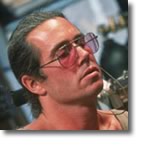 American glass and bronze artist William Morris, considered one of the world's foremost glass
artists, uses the fragile medium of glass and now the strong
medium of bronze to recreate life-size black ravens and exquisite
deer heads that reflect themes of myth, archaeology and the animal. Morris'
limited edition bronze sculptures are created from molds taken
from blown glass originals that are documented in the William
Morris Studio Archives. American glass and bronze artist William Morris, considered one of the world's foremost glass
artists, uses the fragile medium of glass and now the strong
medium of bronze to recreate life-size black ravens and exquisite
deer heads that reflect themes of myth, archaeology and the animal. Morris'
limited edition bronze sculptures are created from molds taken
from blown glass originals that are documented in the William
Morris Studio Archives.
Master glass artist William Morris has
the uncanny ability to manipulate blown glass into something it
really isn't by creating the optical equivalence of bone,
wood, stone and leather. Morris pushes the limit of glass blowing
with his mesmerizing sculptures of spirited forms using extraordinary
technical skills that seem beyond the physical and chemical possibilities
of glass.
Born in 1957 in Carmel, California, William Morris
is also considered to be one of the most gifted and daring
young glass artists in America today. Morris's artwork can
be found in numerous public collections, including: The Metropolitan
Museum of Art, New York, NY; Corning Museum of Glass, Corning,
NY; The Chrysler Museum, Norfolk, VA; The Smithsonian National
Museum, Washington, DC; The Norton Museum, Boca Raton, FL; American
Glass Museum, Millville, NJ; Hokkaido Museum of Modern Art, Hokkaido,
Japan; Musee Des Arts Decoratifs, Paris, France; Auckland Museum,
Auckland, New Zealand and The Victoria and Albert Museum,
London, England.
Morris has traveled worldwide, working with the masters of Italian
glass and others, including American Glass Artist Dale Chihuly.
He has also shared his extraordinary skills in workshops and demonstrations throughout
the globe. Morris currently resides in Washington State near the
renowned Pilchuck Glass School where, during the past twenty five
years, he has been a student, gaffer, teacher and artist in residence,
as well as Artistic Director in 1991and member of the
Board of Directors in 1992.
Morris' unique treatment of surface texture is achieved
by various techniques such as sprinkling powdered glass and minerals
onto a blown surface, etching, and acid washing to achieve "ancient" and
textural diversity. Now working in bronze, Morris continues
to dazzle us with his brilliance, impeccable craftsmanship and
artistic vision.
"Morris's works are not flashy as is much that is created in this
medium, but more quietly beautiful, with their opaque, sensual
surfaces, and luminous color that seems to glow within each piece
as if it were some sort of life force or blood coursing through," states
Patricia Watkinson, Director of the Fort Wayne Museum of Art. His
work invites the visitor to contemplate the ever-widening gap between
contemporary culture, which focuses on technology and progress
and our primitive beginnings, shaped by the forces of nature and
myth.
Morris acknowledges the influence of Italian artists who have
shared their knowledge of techniques for crafting glass, so essential
to the realization of Morris' ideas. Strongly influenced by his interest in archeology
and ancient pagan cultures, Morris explores the timeless relationship between humans
and their enviroment, evoking images from a time when man was more in tune
with nature. Various works such as the Idolo and Idolito
Series, Artifact Vessels, Suspended Artifacts,
and Rhyton Vessels illustrate symbolic and mythological
influences.
Glass and bronze sculptor William Morris' new series
Rhyton represents more than an advance in the expression of message
and content. It also demonstrates why he is considered one of the
world's foremost glass artists. The exquisite shapes, subtle bends,
enticing textures, and bright colorations are superb--and well
harmonized with the primordial themes he is developing. As always,
fascinated by the ideas of nature and death through the vehicle/vessel
of the animal, Morris has drawn upon identifiable horned mammals
such as the bull, stag, antelope, and elk, along with other quadrupeds
like the horse.
"The appearance of animals in dreams or visions expresses an energy still undifferentiated
and not yet rationalized nor yet mastered by the will," notes J.E. Cirlot in
A Dictionary of Symbols. "According to Jung, the animal stands for the non-human
psyche, for the world of sub-human instincts, and for the unconscious." To tap
into this primordial-psychic undercurrent, Morris combined the inspiration he
received from the ceramic grave gifts of the ancient Amlash culture (1350--1000
b.c.) of northwestern Iran, an interest in hunting and archaeology, and his formal
exploration of the vessel.
According to the artist Narcissus Quagliata, "We experience William Morris'
work with the same part of ourselves that responds to Stonehenge. ... [The]
work does not ask the viewer for an intellectual and studied response [but
bypasses] ... words, concepts or thought. Using intuition as his guide, the
artist enters a world of power, beyond culture."
Reminiscent of themes explored in Morris' Petroglyph Vessels series of the
1980s, Rhyton informs us about the forces and energies at play in the natural
world and about our mysterious relationship to the animal kingdom, which serves
man unconditionally and is therefore demanding of our respect. Yet, on a deeper
level Rhyton is an expression of the ongoing relationship between the masculine
(represented by the animal) and the feminine (represented by the vessel), a
symbolic activity that resonates in the consciousness on many levels. The artist
had intended to take a sabbatical in 2001, but his plans were soon overtaken
first by personal, then national grief on September 11. Instead, he sought
solace in work creating the Cinerary
Urns which are by far William Morris's most deeply
personal and intimate body of work. The Chrysler Museum's Curator of
Glass, Gary Baker, referenced the four Cinerary Urns recently acquired
by the museum, as being created by "one the greatest glass artists working
at the height of his creative powers."
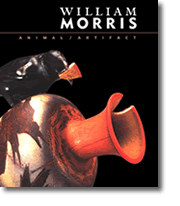 Extensively written about, William Morris' work is
perhaps best described in these words by Tina Oldknow, Curator
of Modern Glass at the Corning Museum of Glass and co-author
of the new Morris book, "Animal/Artifact": "In
looking at Morris' art, we are reminded of what it is to be ancient,
what it is to be human; we momentarily reconnect with that elemental
aspect of our psyches that is prehistoric. This is the territory
that Carl Jung termed the collective unconscious, a potent repository
of meaning and experience. Beyond his technical brilliance in the
craft of blowing and sculpting glass, it is Morris' ability to
enter and work within the realm of the unconscious that makes him
a superior artist." Extensively written about, William Morris' work is
perhaps best described in these words by Tina Oldknow, Curator
of Modern Glass at the Corning Museum of Glass and co-author
of the new Morris book, "Animal/Artifact": "In
looking at Morris' art, we are reminded of what it is to be ancient,
what it is to be human; we momentarily reconnect with that elemental
aspect of our psyches that is prehistoric. This is the territory
that Carl Jung termed the collective unconscious, a potent repository
of meaning and experience. Beyond his technical brilliance in the
craft of blowing and sculpting glass, it is Morris' ability to
enter and work within the realm of the unconscious that makes him
a superior artist."
BORN
July 25, 1957, Carmel, California
EDUCATION
California State University, Chico, California
Central Washington University, Ellensburg, Washington
RECENT AWARDS
2002
- Artist as Hero Award, National Liberty Museum, Philadelphia, PA
2001
- Visionaries Award, American Craft Museum, New York, NY
1997
- Outstanding Achievement in Glass, UrbanGlass Third Annual Awards Dinner,
New York, NY
- Distinguished Alumni Award, California State University, Chico, CA
- Featured Artist, Chateau Ste. Michelle Winery, Artists Series
1994
- National Endowment for the Arts, Individual Artist Grant
Contact Galleria
Silecchia for more on William Morris.
Prices and availability
are subject to change.
The artist reserves all reproduction
and copyrights.

Receive
our Newsletter: Keep up-to-date with current events at Galleria
Silecchia. We’ll let you know what’s happening and
when.
Newsletter Archive


|
© Galleria Silecchia
2000-15 Sarasota, Florida.
All rights reserved.
|
|









